Probing PR: Does proportional representation induce ethnic power sharing and reduce conflict?
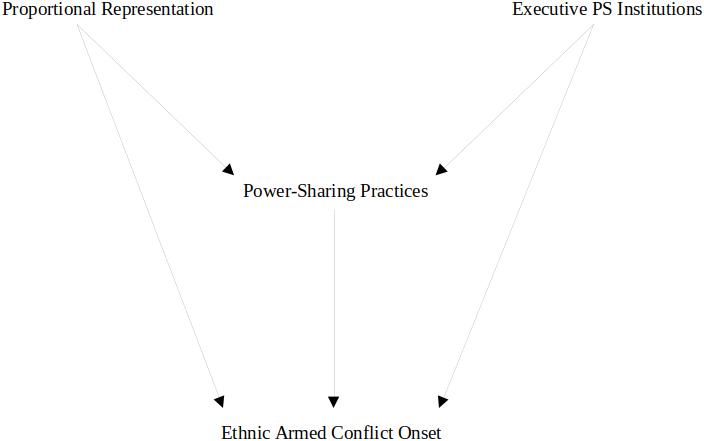 Mechanism: proportional representation, government inclusion, and ethnic armed conflict onset.
Abstract
Recent work on power sharing and civil conflicts in ethnically divided societies emphasizes the crucial distinction between mandates and their implementation. Formal power-sharing rules reduce the risk of armed conflict, but power-sharing practices mediate this effect. Political scientists frequently categorize proportional electoral rules (PR) as part of the broader class of power-sharing institutions, which should induce power-sharing practices, and in turn reduce the likelihood of intrastate armed conflict. Empirical evidence for this claim is indirect at best. Using mediation analysis, we assess whether PR rules or executive power-sharing institutions (or their combination) engender elite power sharing in ethnically divided societies and reduce the risk of ethnic intrastate conflict. Using different datasets, we find no evidence for a positive effect of PR on power-sharing practices, and some weak evidence that PR reduces intrastate conflict through other mechanisms. Recommendations of PR to ethnically divided societies or post-conflict environments as means to foster inclusion and thus reduce conflict should be reconsidered.